advertisement
Balancing act: Catalonia’s castells, or human towers, offer a lesson in sharing the load
On one Saturday in October,colles– groups consisting of people of all ages from all over Catalonia and beyond – parade down the streets of Tarragona accompanied by bands playing Catalan music. Dressed in white trousers, colourful shirts, sashes and bandannas, they make their way to the Tarraco Arena, an amphitheatre in the heart of town. Boys and girls play thegralla, a double-reed instrument, and drums calledtimbals. Their progress announces the 29th edition of the biggest gathering ofcastells, Catalonia’s human towers, which are a feat of collaboration and focus.
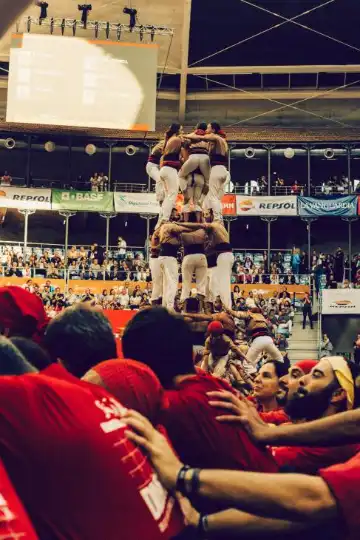
The human towers are the work of amateur groups that meet for rehearsals twice a week in sports halls across the region. The aim is to build towers that can reach up to 10 people high. “It’s nerve-wracking but also exciting,” says Santi Pie, leader of the Castellers de Sant Cugat, from the eponymous town just north of Barcelona. Pie’s group is one of 30 that has qualified to compete in Tarragona over the weekend in this biannual extravaganza. His job today is to co-ordinate almost 300 people as they aim to create the tallest, most intricate tower possible in order to gain a place, alongside 12 othercolles, in the finals of the championship, which take place over the weekend. Monocle joins an audience of 11,000 people, a figure that doesn’t include the thousands ofcastellerstaking part.
Over the past half-century thesecastells, once the result of a relatively marginal activity, have become one of the most potent symbols of Catalan identity. The tradition was declared a Masterpiece of the Oral and Intangible Heritage of Humanity by Unesco in 2010 and, since then, the number ofcolleshas doubled. The pastime originated in the 18th century in the town of Valls in the Tarragona region. Thecollesare thought to have developed from a popular dance tradition called Ball de Valencians; music remains central to the activity. Eachcollahas its own band that starts playing once the base of the tower – thepinya(pine cone) – has been built, and carries on as people climb up to form the upper tiers. The song “El Toc de Castells” guides participants to co-ordinate their movements with the melody, while those at the bottom are able to estimate the tower’s progression via the music.Castellscan be found at festivities across Catalonia, where the towers are often built in front of town halls and not necessarily competitive, though the activity is inherently ambitious.
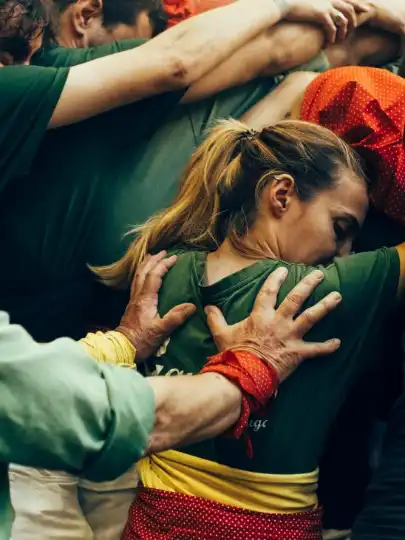
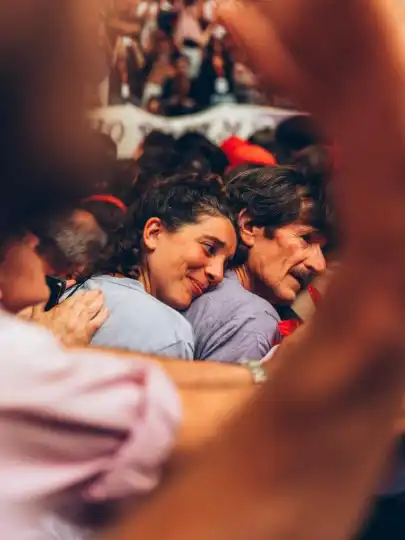
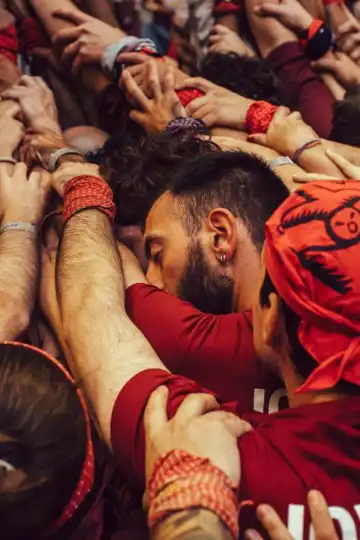
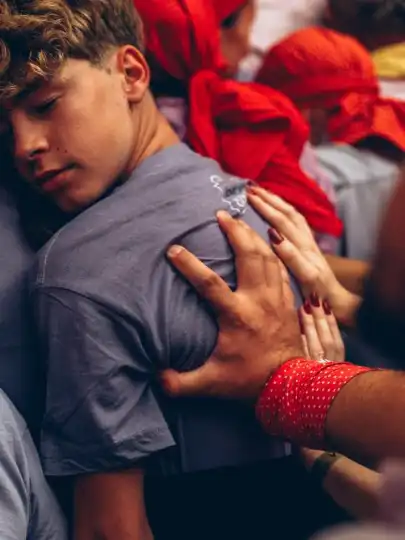
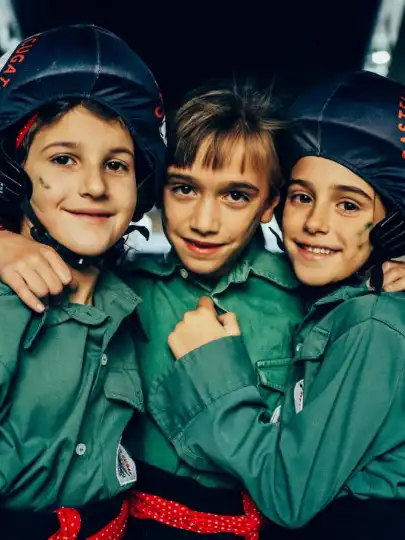
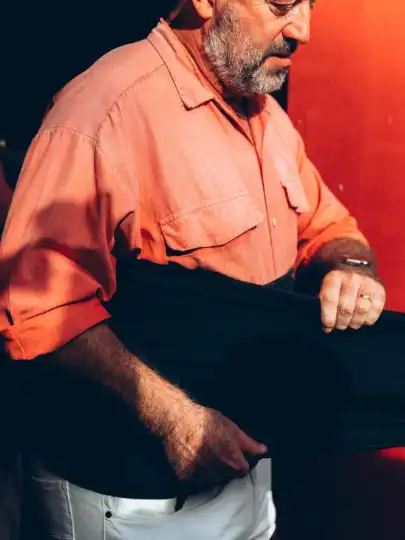
As competitors slowly pile into the centre of the Tarraco Arena Plaça, a former bullfighting ring that has heldcastellscompetitions since 1932, a voice on the loudspeakers introduces eachcolla, many of which have names that hint at the important role played by children: the Xiquets del Serrallo (Kids of El Serrallo); Marrecs de Salt (Brats from Salt); Nens del Vendrell (Children of El Vendrell). Children as young as five or six, whose job it is to climb up to the top of the tower, wear mouthguards and helmets. In pairs, participants help each other to wrap the all-important sash tightly around their waists. This crucial part of their outfit supports the lower back and provides grip for climbers on the ascent. A banner hanging on the edge of the arena reads, “Fent pinya, fas poble.” (“When you huddle together, you make a village.”)
Surveying the crowds from the top floor of the arena is Pere Ferrando, president of the jury. He is surrounded by several screens showing all the action. Allcollesreceive a score based on the difficulty of their constructions, and alongside six other jurors, Ferrando will be marking the performances. There are about 40 different types ofcastells, each of which is only complete when theenxaneta(one of the smallestcastellers) reaches the top of the tower and raises one hand. Extra points are given for a safe dismantling. But today is not only about rivalry. “What makes it interesting is that you don’t necessarily need to compete with anothercolla,” says Ferrando. “It’s also about surpassing yourself.” That said, he will be keeping a close eye on the tug of war between the two teams angling for the tallestcastells: the Castellers de Vilafranca and the Colla Vella dels Xiquets de Valls. The former has dominated the competition since the mid-1990s, winning 11 of the past 13 editions, while the latter is the team threatening this dominance.
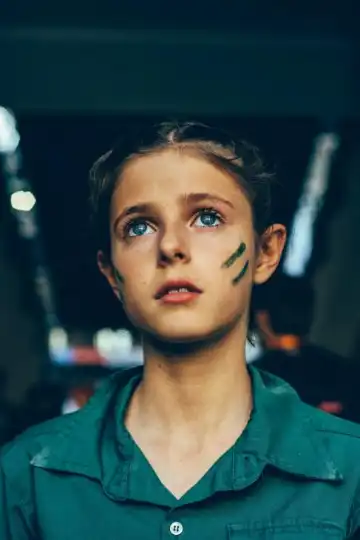
It’s mid-afternoon, and the time has come for the Castellers de Sant Cugat to attempt their first tower – an eight-storey construction with fourcastellersper tier. Pie, the group leader, calls out instructions from the bottom as the stadium watches on. Every step is perfectly synchronised to complete the tower as quickly and safely as possible. As soon as the fourth storey is complete, eight-year-old Candela Casas begins her ascent, stepping on a sea of arms and heads. “I climb up by holding on to sashes, grabbing shoulders and legs,” she says when Monocle meets her backstage. She’s not scared of heights, she says, but it’s important to not look down and to stay focused. When she reaches the top and lifts up her left hand, the stadium breaks into applause. But it’s only when it’s clear that the tower will not crumble, and that everyone is safe, that thecastellersbegin to jump up and down, exchanging hugs and kisses. When asked what the best thing aboutcastellsis, Casas replies without hesitation, “To enjoy yourself!”
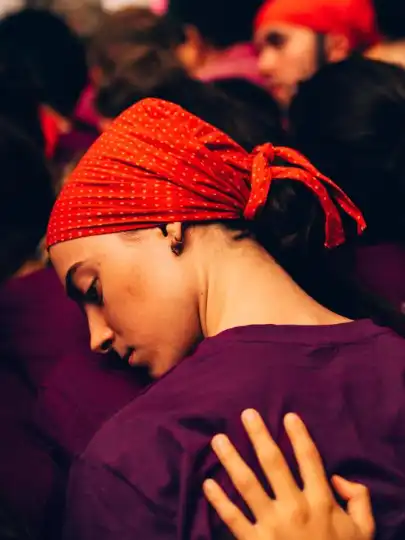
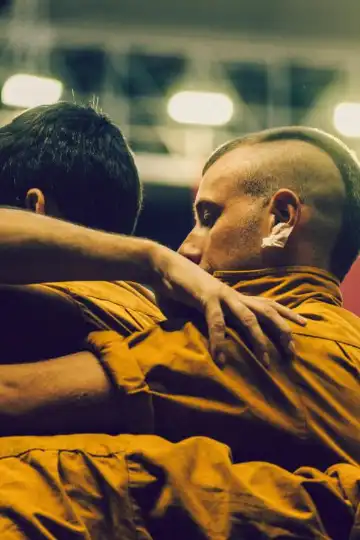
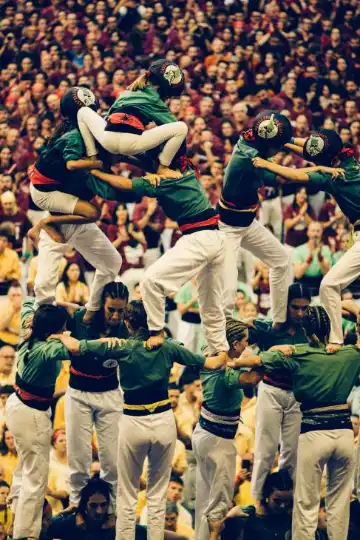
Many participants liken the experience to being part of a huge family. For Maricarmen Álvarez, who is watching nervously from her front-row seat, that is quite literally the case. She is here to support her two daughters and six grandchildren, ranging between the ages of 12 and 23. They are all taking part in the competition with the blue-shirted Xiquets del Serrallo from the Tarragona fishing neighbourhood. “It’s very hard for me to watch,” says Álvarez, pausing to point out every family member as they take their positions in the tower. “Come on, you’re almost there,” she says, cheering on as the youngest reaches the top. “Oh God, please don’t let them fall.”
Of course, not every tower can defy gravity. Though thepinyadoes act as a cushion and serious accidents are rare, the risk involved incastellsis what makes the feat of collaboration so enthralling. Álvarez is acutely aware that this is the price to pay for the strong sense of belonging and community thatcastellsprovide. She knows that it’s the collective bravery and unconditional trust placed in others that has kept the tradition alive. “My late husband was acastellerand my great-grandchildren will probably becastellers,” she says with a sigh. “It’s passed down from generation to generation; it’s in their blood.”
Making his way through the crowd is Tarragona’s mayor, Rubén Viñuelas. When you grow up here, he says,castellsare never far away. “Part of daily life is going out for a vermouth and watchingcastells,” he says, referencing the celebrations of Sant Magí and the Santa Tecla Festival, which take place in August and September. “Tarragona is the capital ofcastells, so this event means a lot to us. We pay homage to this way of life. Those of us who grew up here understand what this means and we love to see people from around the world watch on with excitement.”
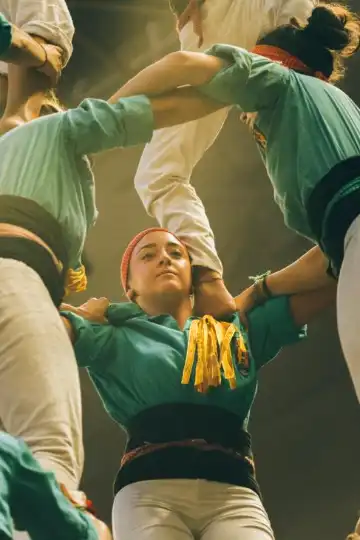
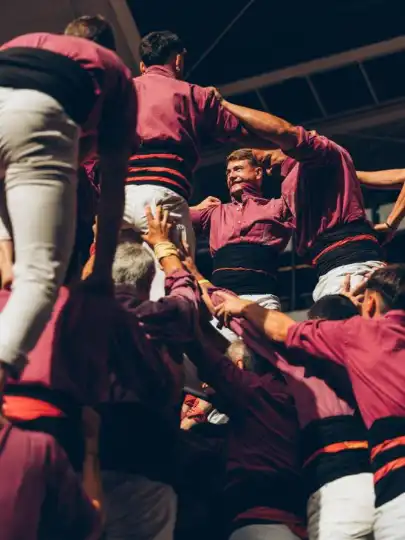
As a strong expression of Catalan identity,castellsoften go hand in hand with a sense of regional pride that can be tied to Catalonia’s independence movement, which came to a head with an ultimately unsuccessful declaration of independence in 2017. The competition begins with everyone singing “Els Segadors”, Catalonia’s national anthem, with hands on hearts and fists in the air. Inevitably, this is followed by calls for “Independència!” Some seecastellsas a metaphor for the region’s strong sense of unity. “There’s the cultural aspect of makingcastells– it’s about looking after our language and the traditions that have been around for hundreds of years,” says Víctor Biete, president of the Castellers de Sant Cugat. Of course, that doesn’t mean that the activity is incompatible with wanting to remain in a united Spain. And whilecastellshave grown in popularity in recent years, the push for independence has suffered some setbacks. For the first time in more than a decade, the Catalan nationalist parties failed to secure a majority of seats in the regional parliament earlier this year. The pro-union Socialist Party, of which Viñuelas is a member, now leads the Catalan government after years in opposition.
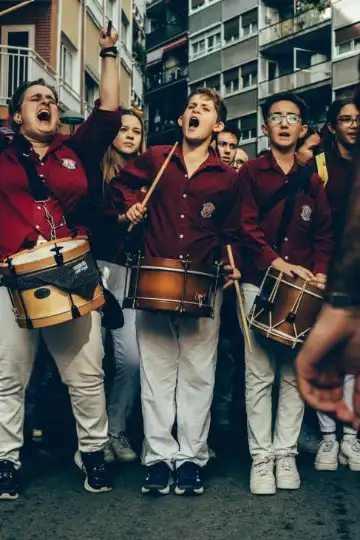
A few streets away, a parallel event is taking place in front of the town hall. In recent decades,castellshave expanded beyond Catalonia’s borders. Today several internationalcolles– from London, Paris, Berlin and Copenhagen – have gathered here before heading to the arena to support the Catalan teams. The Xiquets de Copenhagen were founded in the Danish capital in 2014, and Marta Trius, a PhD student, joined them a year ago. “When you’re abroad, the social dimension becomes even more important,” she says. “When you move abroad you have to find your family and this is like having a family.”
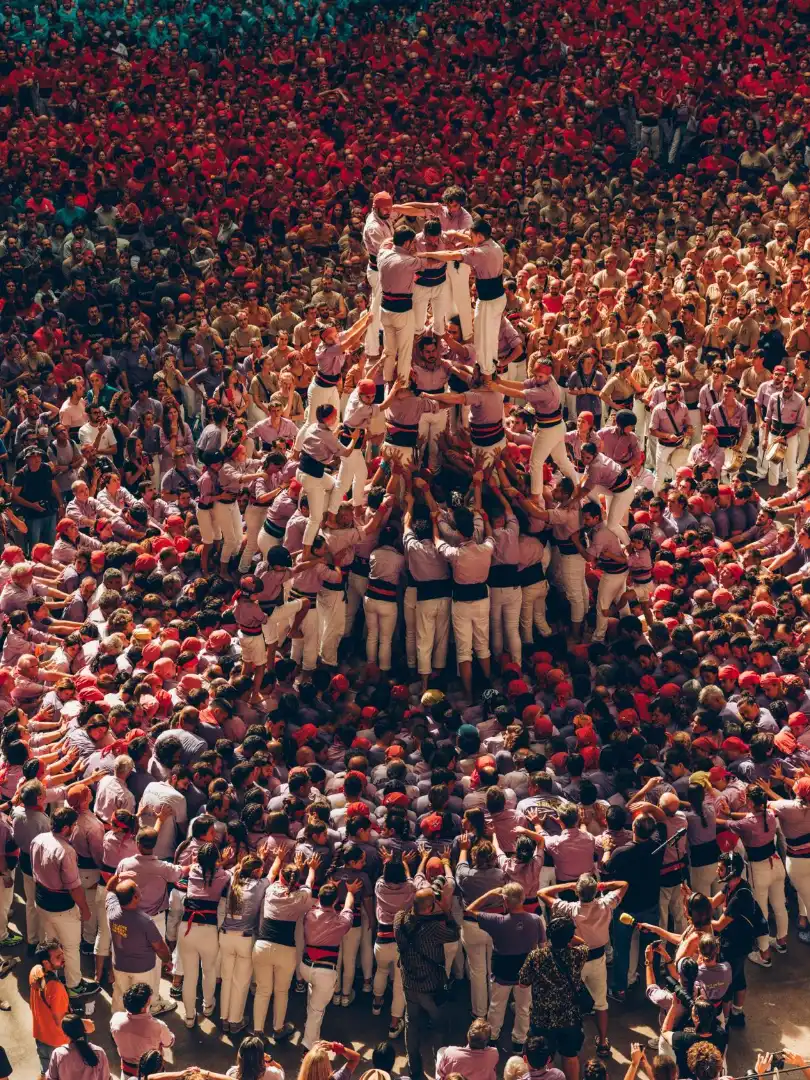
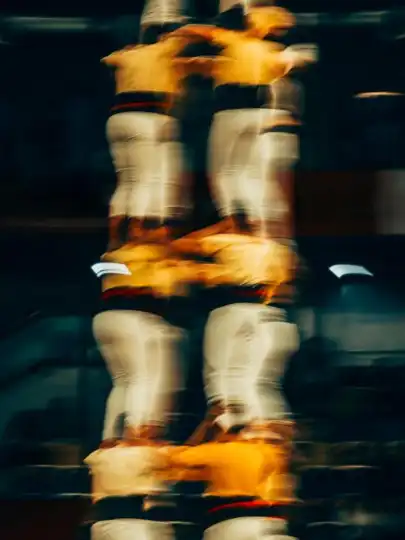
Back in the arena, Viñuelas says that the global appeal ofcastellsis due to the teamwork and inclusivity involved. “It’s a piece of Catalonia that we are exporting to the rest of the world, with all its symbolism,” he says. “Everyone has a function in society – the elderly, men, women, children – just like incastells. And in the end, everything depends on the youngsters; on little boys or girls who rise high above everyone else to complete the tower.” In the end, the Castellers de Vilafranca triumphed, taking home its 13th title. For the other, there’s always next time: you’re only as good as your lastcastell.
advertisement
Most Read